
Performance Marketing vs Digital Marketing: The Ultimate Guide (2026)
Introduction
In today’s hyper-competitive digital landscape, businesses are constantly asking one critical question: should they invest in Performance Marketing vs Digital Marketing? While both fall under the umbrella of online marketing, they serve very different purposes, target different KPIs, and require different mindsets.
This comprehensive guide breaks down everything you need to know — from definitions and differences to benefits, scope, career opportunities, and which strategy is best for your business goals.
| 💡 Quick Insight If you want to pay only for results — leads, clicks, or sales — Performance Marketing is your answer. If you want to build a brand that dominates search, social, and minds, Digital Marketing is the long game. |
What is Digital Marketing?
Digital Marketing is the practice of promoting products, services, or brands through all available digital channels — including search engines, social media platforms, email, websites, and mobile apps. It is an umbrella term that covers every form of online marketing activity.
Key Components of Digital Marketing:
- Search Engine Optimisation (SEO) — Organic ranking on Google & Bing
- Social Media Marketing (SMM) — Facebook, Instagram, LinkedIn, Twitter/X
- Content Marketing — Blogs, videos, infographics, podcasts
- Email Marketing — Newsletters, drip campaigns, re-engagement flows
- Pay-Per-Click Advertising (PPC) — Google Ads, Meta Ads
- Online Reputation Management (ORM)
- Affiliate Marketing
- Video Marketing & YouTube SEO
- Google My Business & Local SEO
Digital Marketing is both art and science — it combines creative storytelling with data-driven decision-making to attract, engage, and convert audiences across the entire customer journey.
| 📌 Definition Digital Marketing = Any marketing activity conducted through a digital channel or device with the goal of reaching consumers, building brand equity, and driving business outcomes. |
What is Performance Marketing?
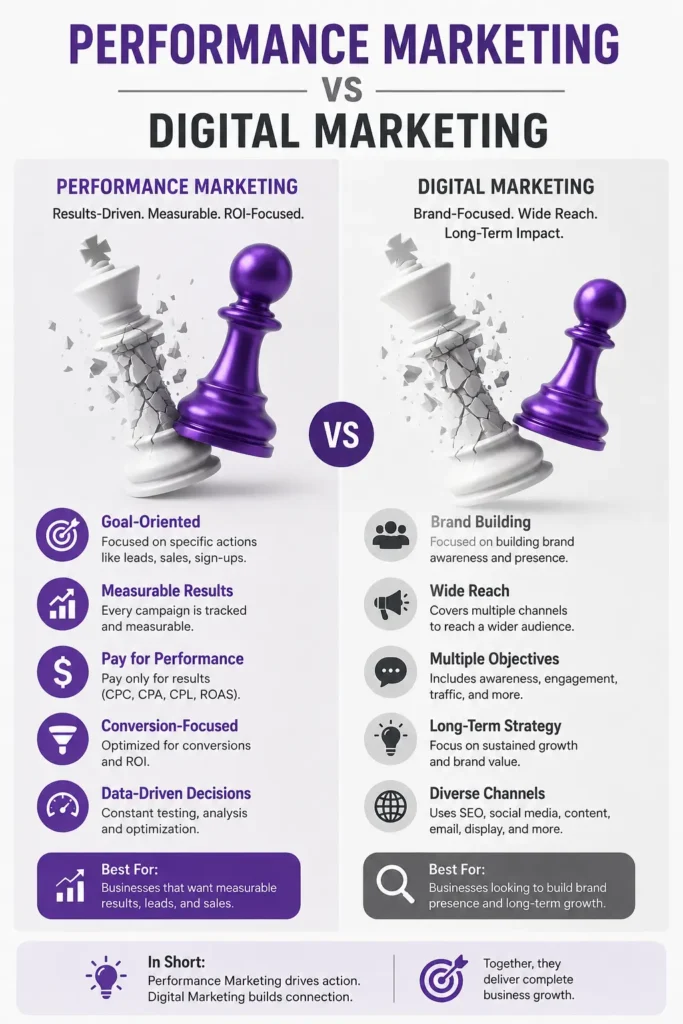
Performance Marketing is a results-first, ROI-driven subset of digital marketing where advertisers pay only when a specific, measurable action occurs — such as a click, lead, sale, app install, or sign-up. It shifts the risk from advertiser to publisher or platform.
Core Performance Marketing Channels:
- Google Ads — Search, Display, Performance Max (PMax), Shopping
- Meta Ads — Facebook & Instagram lead generation and conversion campaigns
- Programmatic Advertising — DSPs, RTB bidding
- Affiliate Marketing — Commission-based partner channels
- Influencer Performance Deals — Pay-per-sale collaborations
- Retargeting & Remarketing Campaigns
- Amazon Ads & Marketplace Performance Campaigns
Key Metrics in Performance Marketing:
- CPC — Cost Per Click
- CPL — Cost Per Lead
- CPA — Cost Per Acquisition
- ROAS — Return on Ad Spend
- CTR — Click-Through Rate
- CVR — Conversion Rate
- LTV — Lifetime Value
| 📌 Definition Performance Marketing = A data-driven marketing model where every rupee/dollar spent is tracked against a measurable outcome. You pay for performance, not promises. |
Key Differences: Performance Marketing vs Digital Marketing
Understanding the difference between Performance Marketing and Digital Marketing is essential before you invest your budget. Here is a side-by-side comparison:
| Parameter | Performance Marketing | Digital Marketing |
| Definition | Results-driven; pay for measurable outcomes only | Broad online promotion across all digital channels |
| Focus | ROI, ROAS, CPA, CPL, conversions | Awareness, engagement, reach, brand building |
| Budget Model | Pay-per-result (CPC, CPL, CPA, ROAS-based) | Fixed or flexible spend across channels |
| Measurement | Real-time KPIs — clicks, leads, sales | Mix of qualitative + quantitative metrics |
| Risk | Low — you pay only when results are delivered | Higher — budget spent regardless of outcomes |
| Timeline | Short-term, campaign-driven results | Long-term brand building + short-term wins |
| Channels | Google Ads, Meta Ads, Affiliate, Programmatic | SEO, Social, Email, Content, PPC, ORM |
| Best For | E-commerce, lead gen, direct response brands | Building authority, awareness & long-term growth |
| Skillset | Analytics, bidding, attribution, tracking | Multi-channel strategy, content, SEO, design |
| Reporting | Attribution-focused, granular data | Holistic dashboards (GA4, GSC, social analytics) |
In summary: Digital Marketing is the house; Performance Marketing is one powerful room inside it — specifically built for maximising measurable results.
Benefits of Performance Marketing
Here are the top benefits that make Performance Marketing one of the fastest-growing disciplines in the marketing world:
1. You Pay Only for Results
Unlike traditional advertising or broad digital campaigns, performance marketing ensures every rupee you spend is tied to a specific outcome. No results = no spend. This makes it highly cost-efficient.
2. Real-Time Tracking & Attribution
Every click, conversion, and rupee is tracked in real time using platforms like Google Analytics 4 (GA4), Google Ads, Meta Ads Manager, and third-party tools. You know exactly what’s working.
3. Scalable & Flexible
Once you find a winning campaign, you can scale budget instantly. Drop what’s not working. Double down on what is. This agility is unmatched in any other marketing model.
4. Highly Targeted Audience Reach
Performance marketing allows hyper-targeting based on demographics, location, intent signals, device type, behaviour, and remarketing lists — ensuring your ads reach the right person at the right time.
5. Clear ROI & Measurable KPIs
ROAS, CPA, and CPL give you a crystal-clear picture of your return. Stakeholders love it. CFOs love it. It removes guesswork from marketing budgets.
6. Low Risk for Advertisers
In affiliate and pay-per-lead models, you only pay when the desired action happens. Publishers bear the upfront cost of driving traffic.
7. Multi-Channel Reach
Run simultaneously on Google, Meta, LinkedIn, programmatic networks, and affiliate platforms — all tracked under a single attribution model.
8. A/B Testing at Speed
Test multiple ad creatives, copy variants, landing pages, and bid strategies simultaneously and optimise in days, not months.
Benefits of Digital Marketing
Digital Marketing, when executed strategically, builds the kind of authority and trust that no paid campaign can buy overnight:
1. Builds Long-Term Brand Equity
A robust SEO strategy, consistent content, and an active social presence compound over time. Your brand becomes the first name people think of in your category.
2. Cost-Effective at Scale
Organic channels like SEO and content marketing have near-zero marginal cost once established. A top-ranked blog post drives traffic for years without ongoing spend.
3. Wider Audience Reach
Digital marketing reaches audiences at every stage of the funnel — awareness, consideration, decision — through multiple touchpoints.
4. Builds Trust & Credibility
Consistent content, positive reviews, and thought leadership position your brand as an industry authority — something performance ads alone cannot achieve.
5. Supports Every Business Size
Whether you’re a freelancer, a local business, or an enterprise, digital marketing has channels and strategies that fit every budget and goal.
6. Data-Driven Decision Making
Tools like GA4, Google Search Console (GSC), SEMrush, and Ahrefs give deep insights into audience behaviour, keyword rankings, and competitor gaps.
7. Global + Local Reach
From targeting Dehradun audiences via Local SEO and Google My Business to running global campaigns — digital marketing bridges local and global seamlessly.
Advantages of Performance Marketing over Digital Marketing
While both are powerful, Performance Marketing has specific advantages that make it the preferred choice for direct-response brands and growth-focused businesses:
| Advantage | Why It Matters |
| Immediate results | See conversions from Day 1 — no waiting months for organic growth |
| Budget accountability | Every rupee has a tracked outcome — ideal for reporting to clients/stakeholders |
| Predictable CAC | Consistent Cost of Acquisition helps forecast growth and profitability |
| Campaign agility | Pause, scale, or pivot campaigns in real time based on data |
| Higher conversion intent | Search ads target bottom-of-funnel users actively looking to buy |
| Competitive advantage | Outbid competitors for top ad slots during peak buying seasons |
| Retargeting power | Re-engage warm audiences who already showed purchase intent |
| Attribution clarity | Know exactly which channel, keyword, or ad drove the conversion |
Scope: Performance Marketing vs Digital Marketing in 2026
Both fields are growing rapidly in India and globally. Here’s what the scope looks like for professionals and businesses:
| Performance Marketing Scope | Digital Marketing Scope |
| Google Ads (Search, Display, PMax) | Search Engine Optimisation (SEO) |
| Meta Ads (Facebook & Instagram) | Content Marketing & Blogging |
| Affiliate & Influencer Marketing | Social Media Marketing (SMM) |
| Programmatic Advertising | Email Marketing & Automation |
| CRO & Landing Page Optimisation | Online Reputation Management (ORM) |
| Retargeting & Remarketing | Video Marketing & YouTube SEO |
| Amazon Ads & Marketplace Ads | Google My Business & Local SEO |
| App Install & In-App Campaigns | Influencer & Community Building |
Career Scope — Performance Marketing:
- Performance Marketing Manager (avg. ₹6–18 LPA in India)
- Google Ads Specialist / PPC Expert
- Paid Social Media Strategist
- Media Buying Analyst
- Growth Hacker / Demand Generation Lead
- Freelance Performance Marketer (₹50k–₹2L/month)
Career Scope — Digital Marketing:
- Digital Marketing Manager (avg. ₹5–15 LPA)
- SEO Specialist / Content Strategist
- Social Media Manager
- Email Marketing Specialist
- Digital Marketing Trainer / Consultant
- Agency Head / Freelance Digital Marketer
| Market Insight India’s digital advertising market is projected to surpass ₹35,000 crore by 2026 (IAMAI). Performance Marketing is the fastest-growing segment, driven by e-commerce, fintech, edtech, and D2C brands scaling aggressively on Google and Meta. |
Why Choose Performance Marketing?
Choose Performance Marketing if one or more of these apply to your situation:
- You want immediate, measurable results (leads, sales, sign-ups)
- You are running an e-commerce, D2C, fintech, edtech, or real estate business
- Your board or clients demand clear ROI on every marketing rupee
- You have a defined CPA or ROAS target you need to hit
- You want to scale fast and can invest in paid media
- You are launching a new product and need rapid market validation
- You want to retarget warm audiences and close the conversion gap
- You are a freelancer or agency looking to deliver trackable results for clients
| 🚀 Pro Tip for Businesses Start with Google Search Ads targeting bottom-of-funnel (BoFu) keywords — these users already want to buy. Layer in remarketing campaigns to re-engage non-converters. This is the fastest path to positive ROAS. |
Why Choose Digital Marketing?
Digital Marketing is the right strategy when:
- You want to build long-term organic visibility (SEO-first strategy)
- Your brand is new and needs awareness before selling
- You have a limited budget and need cost-effective, sustainable growth
- You are in a high-trust industry (finance, healthcare, legal) where authority matters
- You want to build a community or loyal customer base
- Your product has a long sales cycle requiring multiple touchpoints
- You want to dominate local search in a specific geography
- You are a personal brand, coach, trainer, or consultant
Which Is Best For Your Business?
The honest answer: the best strategy is an intelligent combination of both. Here’s a quick decision guide:
| Business Type | Best Strategy | Why |
| E-commerce / D2C | Performance Marketing First | Immediate sales, ROAS tracking, seasonal scaling |
| Local Service Business | Digital Marketing (Local SEO) | GMB, local SEO, and reviews drive walk-ins |
| SaaS / B2B | Both (Hybrid) | SEO for inbound + LinkedIn Ads for lead gen |
| Personal Brand / Trainer | Digital Marketing First | Authority, content, and community-building win |
| Startup / New Brand | Both (Phased) | Paid for early traction, SEO for long-term moat |
| Real Estate / Finance | Performance Marketing | Lead gen campaigns deliver qualified inquiries fast |
| Educational Institution | Both (Hybrid) | Brand awareness + targeted admission campaigns |
Major Points to Remember
| Key Takeaway #1 Performance Marketing is a subset of Digital Marketing — not its replacement. Every performance campaign lives within the broader digital ecosystem. |
| Key Takeaway #2 SEO and Content Marketing take 3–6 months to show results; Google Ads can generate leads on Day 1. Use both to cover short-term and long-term business goals. |
| Key Takeaway #3 Attribution is the backbone of performance marketing. Always set up proper conversion tracking (GA4 + Google Ads + Meta Pixel) before spending a single rupee. |
| Key Takeaway #4 In India, Tier-2 cities like Dehradun are rapidly adopting digital marketing. Local businesses that combine Local SEO + Google Ads are seeing 3–5x lead growth. |
| Key Takeaway #5 Performance Marketing is not just about spending money — it’s about spending smartly. A well-optimised ₹50,000/month campaign can outperform a poorly managed ₹5 lakh campaign. |
Additional Must-Know Points:
- Google’s Performance Max (PMax) campaigns are redefining performance marketing — they automate across all Google channels using AI
- First-party data (email lists, CRM data) is becoming critical as third-party cookies phase out — critical for both disciplines
- Video ads (YouTube, Instagram Reels) are the fastest-growing performance marketing format in India in 2026
- Landing page quality directly impacts both Google Ads Quality Score and conversion rate — optimise both for performance wins
- Audience segmentation (cold, warm, hot) is the #1 lever for improving ROAS in performance campaigns
- Digital Marketing is a career that compounds — skills in SEO, content, and paid media compound into high-value expertise over time
13. Frequently Asked Questions (FAQs)
Q: What is the main difference between Performance Marketing and Digital Marketing?
A: Digital Marketing is a broad term covering all online marketing activities including SEO, social media, email, and paid ads. Performance Marketing is a results-driven subset where you pay only for specific outcomes like clicks, leads, or sales. All Performance Marketing is Digital Marketing, but not all Digital Marketing is Performance Marketing.
Q: Is Performance Marketing better than Digital Marketing?
A: Neither is universally better — they serve different goals. Performance Marketing delivers fast, measurable ROI for direct-response campaigns. Digital Marketing builds long-term brand equity and organic presence. The best businesses use both strategically.
Q: What are the key metrics in Performance Marketing?
A: The core KPIs are CPC (Cost Per Click), CPL (Cost Per Lead), CPA (Cost Per Acquisition), ROAS (Return on Ad Spend), CTR (Click-Through Rate), CVR (Conversion Rate), and LTV (Lifetime Value).
Q: Which is better for lead generation — Performance Marketing or Digital Marketing?
A: Performance Marketing (specifically Google Search Ads and Meta Lead Gen Ads) is the fastest and most measurable way to generate leads. However, SEO and content marketing generate high-quality organic leads over time with zero ongoing ad spend.
Q: What is the salary of a Performance Marketer in India?
A: In India, a Performance Marketing specialist earns between ₹4–12 LPA at the junior to mid level. Senior Performance Marketing Managers and Heads of Growth can earn ₹15–30 LPA or more, especially in metro cities and funded startups. Freelance performance marketers in India typically charge ₹30,000–₹1,50,000 per month depending on ad spend managed.
Q: Can a small business in Dehradun use Performance Marketing?
A: Absolutely. Google Search Ads with local targeting and a daily budget of ₹500–₹1,500 can generate qualified leads for local businesses in Dehradun. Combined with Local SEO and Google My Business optimisation, small businesses can compete very effectively with larger players.
Q: What tools are used in Performance Marketing?
A: Key tools include Google Ads, Meta Ads Manager, Google Analytics 4 (GA4), Google Search Console (GSC), SEMrush, Ahrefs, Hotjar (for CRO), and third-party attribution platforms like AppsFlyer or Branch for mobile campaigns.
Q: How long does it take to see results from Digital Marketing vs Performance Marketing?
A: Performance Marketing can generate results within hours to days of launching. SEO and content marketing (core Digital Marketing channels) typically take 3–6 months to show significant results, but deliver compounding, long-term growth.
Q: Is Digital Marketing a good career in 2026?
A: Yes — digital marketing is one of the fastest-growing career fields in India and globally. With brands accelerating digital spends post-pandemic, there is strong demand for SEO specialists, performance marketers, content strategists, and social media managers at all levels.
Q: What is Performance Max (PMax) in Google Ads?
A: Performance Max is Google’s AI-powered campaign type that runs ads across all Google channels — Search, Display, YouTube, Gmail, Maps, and Discover — from a single campaign. It uses machine learning to optimise bids, creatives, and placements for maximum conversions against your set goals.
Conclusion
Performance Marketing and Digital Marketing are not rivals — they are partners in a winning marketing strategy. Performance Marketing gives you precision, accountability, and speed. Digital Marketing gives you authority, trust, and long-term growth.
Smart businesses and marketers don’t choose between the two. They master both — using performance campaigns to drive immediate revenue while building their digital presence through SEO, content, and social media for sustainable dominance.
Whether you are a business owner in Dehradun looking to generate leads, a freelancer building a portfolio, or a student choosing a career path — understanding both disciplines gives you a decisive advantage in today’s digital-first economy.
| Final Word The future belongs to marketers who can think strategically across the full digital funnel — from organic brand building to data-driven performance campaigns. Invest in both. Track everything. Optimise relentlessly. |